

Thursday last week, Jack Dorsey, CEO of Block, publicly published the company-wide note he sent. The context? He decided to lay off 40% of the company.
From over 10,000 employees down to just under 6,000. Over 4,000 people were asked to leave or enter into consultation.
The stock surged over 20% on the news. That reaction should tell you everything about where this is heading.
In his note, Dorsey was clear about why. When companies lay people off, it’s usually because the business is struggling. That wasn’t the case here. Gross profit is growing, profitability is improving, and their customer base is expanding. But the rapid progress in AI tooling has changed the math. Non-technical teams are more efficient. Internal tools are replacing external vendors. Smaller, flatter teams are getting more done. The number of people needed to run the company is shrinking fast.
Dorsey was left with a choice. Rounds of layoffs, gradual cuts over months or years, or be honest about where things stand and act now. He chose to rip the bandaid off.
I think people who have not been paying attention to how quickly AI is moving may be surprised by this news. But what I keep coming back to is not the layoff itself, it’s the stock price reaction. Because that reaction just gave every other executive in the country the green light to do the same thing.
The Buyback Parallel
Stock buybacks have been the dominant form of financial engineering at the company level for the past two decades. The playbook is simple. A company buys back its own shares, reducing the number of shares outstanding. Fewer shares means earnings per share goes up, even if the business isn’t actually growing. Stock goes up. Executives get paid. Shareholders are happy.
Buybacks weren’t even legal until 1982. Since then they’ve grown into the single largest form of capital return to shareholders, outpacing dividends by roughly 2:1 in recent years.
The post-2008 era showed how quickly this kind of strategy scales once the incentives are in place. The economy was in shambles. Millions lost jobs, homes, savings. And yet within a few years, corporations were borrowing at near-zero interest rates and pouring hundreds of billions into buybacks.
S&P 500 buyback spending went from roughly $150 billion annually in the early 2000s to over $800 billion by 2018. After the 2017 tax cuts, it accelerated further as companies used the windfall for repurchases rather than hiring. A 1% excise tax was introduced in 2023 and it barely slowed them down. In 2024, S&P 500 companies spent a record $942.5 billion on buybacks. In 2025, that number crossed $1.1 trillion.
The mechanism works because the market rewards it. Rather than trying to identify opportunities to grow the business, it is the path of least resistance while still rewarding executives and shareholders. Boards adopted buybacks en masse once they saw how consistently the market responded. It spread from a handful of companies to nearly every public company in America.
Not because every company needed to do it, but because the incentive structure made it the obvious play.
AI layoffs are following the exact same arc.
Companies don’t even need to innovate or grow product lines to benefit from this. They can cut headcount dramatically under the air cover of artificial intelligence replacing jobs across the workforce.
Human resources are most companies’ biggest expense. Cut that line item and margins expand immediately, fundamentals improve on paper, and the stock reacts. There’s also a real opportunity to maintain or even grow output with AI tools and technology. But the margin expansion alone is enough to move the stock.
Block just demonstrated the proof of concept, and the market’s response was about as clear as it gets. A 20% move on the day of a mass layoff at a company that’s already profitable.
Just like buybacks, this will spread. Not because every company needs to cut 40% of its workforce, but because the market will reward the ones that do.
Once boards see what happened to Block’s stock price, the calculus changes. The question shifts from “should we do this” to “when do we do this and how do we communicate it.”
I think AI layoffs will follow the same growth trajectory as buybacks, probably faster. Everything moves faster in the AI era. But the pattern is the same. A handful of companies prove it works, the market rewards them, and then everyone follows.
Dorsey just created the template.
The Question Nobody’s Asking
In the short to medium term, this is bullish for stock prices. Companies that can demonstrate they’re doing more with less, leveraging AI to maintain output while cutting costs, will be rewarded by the market. Asset prices go up. Margins improve. The numbers look great on paper.
But longer term, I genuinely don’t know what happens.
The US economy is 60-70% consumer spending. If companies across the board pursue this strategy, and I think many will, the downstream effects are significant. Fewer jobs means less disposable income. Less disposable income means less consumer spending. Less consumer spending means less revenue for the companies that just cut their workforce to improve margins.
It’s a feedback loop that nobody is really talking about yet.
Who Benefits?
There’s another dimension to this that I think is worth raising. The top 10% of US households already own roughly 90% of all stocks. The top 1% alone owns over 50%. If this strategy plays out the way I think it will, stock prices go up, which disproportionately benefits the people who already own the most.
Meanwhile, the people being laid off are losing their primary source of income. You end up with more wealth concentration at the top and more economic pressure at the bottom. I could see this accelerating calls for universal basic income or similar programs. The political tension between the people benefiting from rising asset prices and the people being displaced by the strategy driving those prices is only going to intensify.
The people most at risk are not the 20-somethings and 30-somethings who are willing to learn new tools and adapt. It’s the 40s and 50s cohort. Middle management. People who have been on the conventional path for decades, maybe coasting a bit, doing their work but not necessarily going above and beyond.
These are also the people with mortgages, families, and real consumer spending tied to their income. That’s the part of the economy that gets pressured when this scales.
Obviously it’s my best guess, but that’s how I currently think about it. Short to medium term, these layoffs become the next leg of financial engineering to keep asset prices moving. Longer term, the implications for the consumer economy are an open question.
The Window
Here’s where I’ll leave you.
Look at the AI usage data right now. 84% of the global population has never used AI. About 16% have used a free chatbot. Only 0.3%, roughly 15-25 million people globally, actually pay for an AI tool. And the subset that uses AI with any real proficiency to build, create, or accelerate their work is even smaller than that.
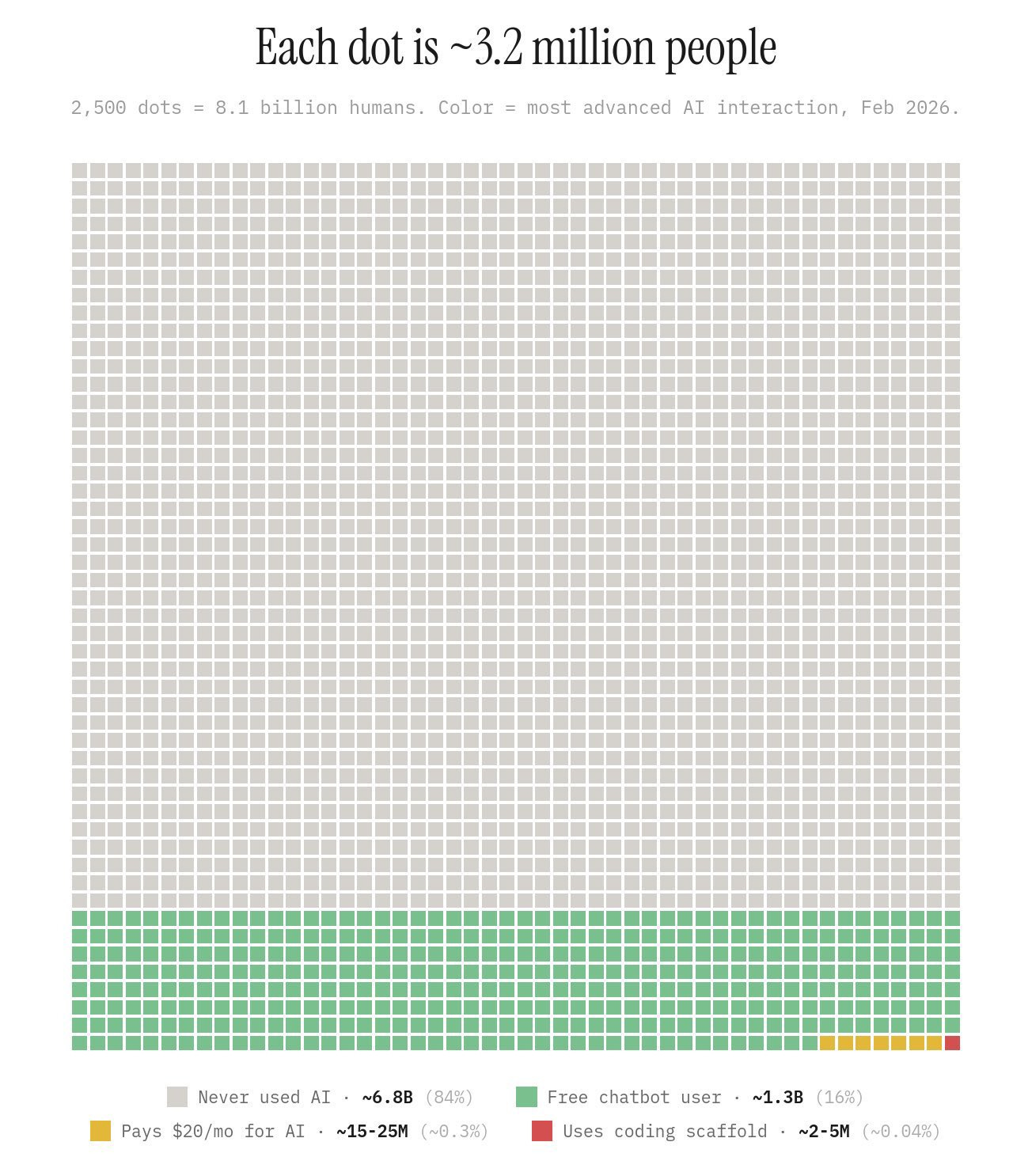
If AI layoffs are the new stock buybacks, and I believe they are, then a wave of these is coming. More companies will follow Block’s lead. The market will reward them for it. The number of people needed to run a business is going to keep shrinking.
Your opportunity in this environment is to be on the right side of that equation. Be the person who is learning these technologies, building with them, and becoming more valuable because of them. Not the person who gets replaced by them.
The window to get ahead of this is wide open. Most people aren’t even in the game yet. That’s the arbitrage.
If you found this valuable, share it with someone who needs to read it. I'm not writing about this from the sidelines. I work in financial services, I use these AI tools every day, and I'm watching this play out in real time. I write about what I'm seeing and thinking every week. Join me!
Fantastic write-up, thank you. Those stats on AI paid usage (which is where the power comes from) are shocking for those of us who live in that 0.3% bubble/echo-chamber.
Jackson, amazing and informative analysis. Talk about seeing around corners! Keep up the good work!