

One of the books that has stuck with me the most over the past several years is The Price of Tomorrow by Jeff Booth. I think it might be one of the most important books someone could read right now to better understand the two major forces at play in the global financial system.
The reason it stuck with me is because it lays out, with real clarity, a tension that I believe underpins everything happening in markets and the economy today. And it is arguably the biggest dynamic in the system right now.
The main thesis is this. Technology is deflationary. It allows us to do more with less, and it naturally wants to drive prices down over time. But the monetary system is inflationary. It is built on debt, and it requires ever more dollars, ever more credit, and ever more debt to keep the whole thing afloat.
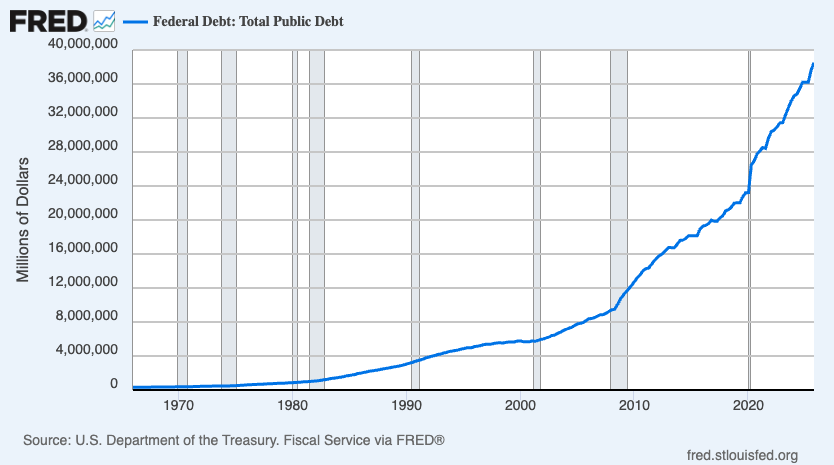
The simplest way to see this is to look at the federal debt, which has exploded from roughly $400 billion in 1971, when Nixon closed the gold window, to over $38 trillion today.
These two forces are completely at odds with each other. They are on a collision course, and most people have no idea it is happening.
The System Needs Prices to Rise
Here is the simplest way to understand why.
The entire financial system runs on credit. Governments borrow, businesses borrow, consumers borrow. The stability of the system depends on the ability to service and roll over that debt. And that only works if the economy is growing, which in practice means prices need to keep rising.
Think about it this way. A business takes out a $1 million loan because they expect to sell $2 million worth of product. Their revenue covers operating costs, debt payments, and leaves a margin. The math works. But what if prices start falling? If that same business can only sell $1.2 million, or $800,000, the loan doesn’t get easier. It gets harder. The debt stays fixed while revenue shrinks. At some point, they can’t make the payments.
Now multiply that across every business, every mortgage, every government bond in the system. That is why deflation is an existential threat to a debt-based economy. It is not that falling prices are inherently bad for people. It is that the math of the debt breaks if they do.
This is why central banks have explicit inflation targets. It is why the Federal Reserve will do almost anything to prevent sustained deflation. It is a structural requirement to keep the system afloat.
And the scale of the debt makes it more urgent, not less.
In his book, Booth points out that between 2000 and 2018, global debt grew from roughly $62 trillion to over $247 trillion. In that same period, the global economy only grew from about $33.5 trillion to $80 trillion. It took approximately $185 trillion of new debt to generate about $46 trillion of growth. That is roughly $4 of debt created for every $1 of economic output.
Imagine pitching that to a bank as a business plan. Even if you taxed the entire $1 of growth at 100%, you could never repay the original loan.
The so-called growth in the economy is largely a function of creating more debt and more currency to stimulate economic activity. The second that stimulation stops and liquidity dries up, you get a massive credit contraction and the system starts to unravel. So governments keep spending and central banks keep printing, because the alternative is a deflationary spiral they cannot allow.
As Ray Dalio puts it, when debt gets out of hand, governments have four options: austerity, debt restructuring, money printing, or wealth transfers. But austerity and restructuring trigger the exact collapse everyone fears. Wealth transfers don’t happen at sufficient scale without revolution. So they print. Every time.
Technology Wants the Opposite
Meanwhile, technology is pushing the cost of nearly everything exponentially lower.
In 1972, Hewlett-Packard released the HP-35 scientific calculator. It sold for $395, which is over $2,900 in today’s dollars. Now compare that to an iPhone, which you can get for around $600, and can do a whole lot more than a scientific calculator.
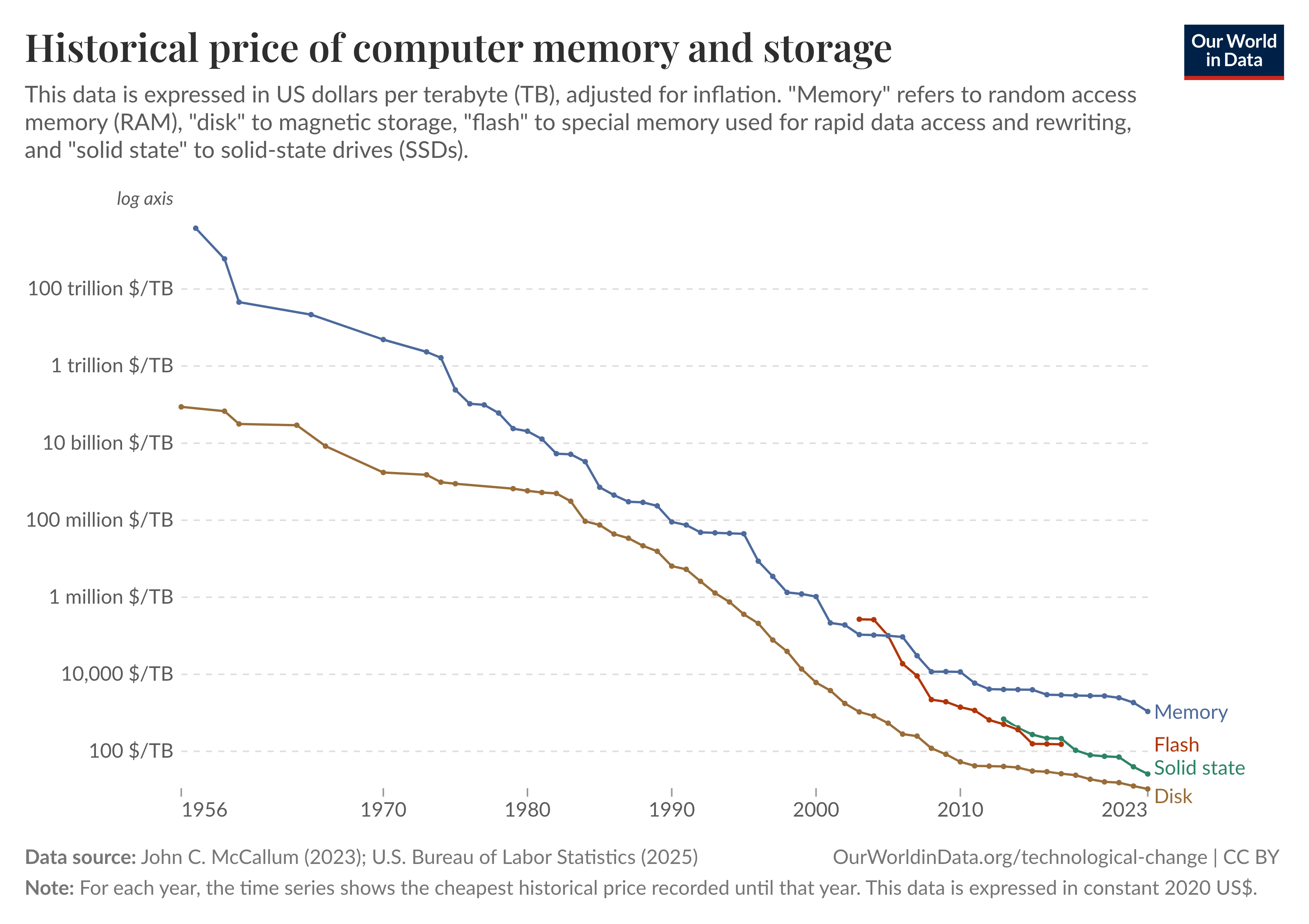
Technology has always been a deflationary force. The internet disrupted media, publishing, travel, banking, advertising, and far more. It changed how products and services were distributed and accessed.
But here is an important distinction. The internet mostly disrupted distribution. It changed how things reached you, but it still required humans to create the underlying product. You still needed the journalist, the analyst, the designer, the engineer. The internet made their output more accessible. It did not replace the work itself.
AI is different. AI is disrupting production. It is going after the labor required to create the thing, not just the channel through which it reaches you. That is a fundamentally different kind of deflationary pressure because it attacks the biggest cost structure in any business: human capital.
What happens when a startup can do what a large incumbent does at one hundredth of the cost? An established company has 200 employees, $20 million in payroll, office leases, legacy systems, and debt on its books. A new entrant with five people and AI tools delivers the same product at a fraction of the price. The incumbent’s clients leave or demand lower prices. Revenue compresses, but the debt stays fixed. Layoffs follow. Those people stop spending. The businesses around them lose customers. Tax receipts drop. The deflationary spiral begins.
Now multiply that across thousands of companies in dozens of industries simultaneously. That is what makes this moment different from anything Booth could have pointed to when he wrote the book six years ago. The internet caused enormous disruption just by changing distribution, and that transition took decades and left a lot of pain in its wake. What happens when the disruption hits production itself, across nearly every sector, at the same time?
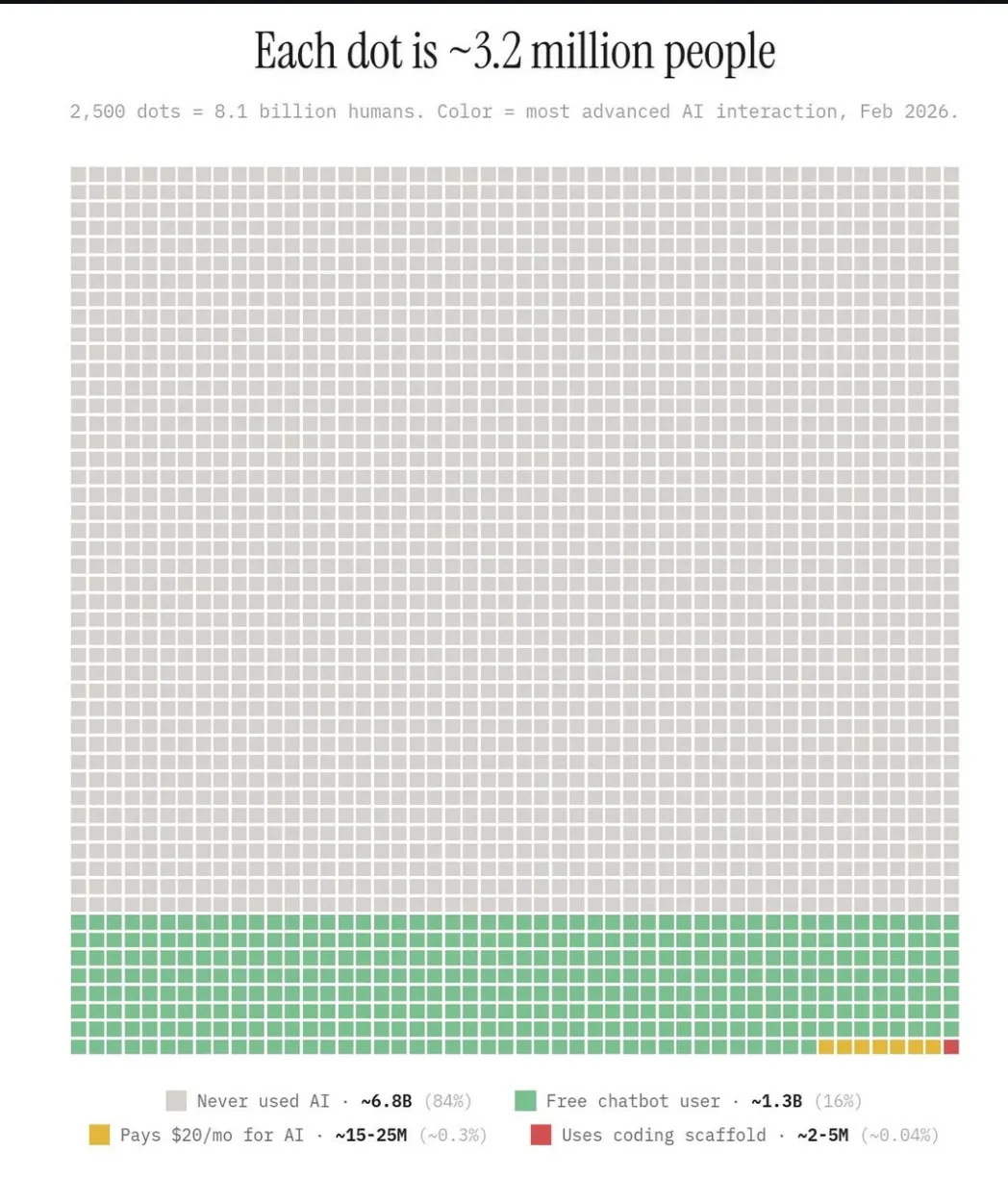
And we are still incredibly early. Roughly 84% of the global population has never used an AI tool. Less than 1% pay for one. The disruption curve has barely started.
In a natural state, all of these forces should be driving prices lower over time. Technology should be making life more affordable for everyone. That is what deflation from innovation looks like. It is a good thing. It means abundance.
But the financial system cannot allow it.
The Collision
This is the tension. Technology is becoming exponentially more deflationary. And the debt is becoming exponentially larger. So the central bank’s response will have to become exponentially more aggressive.
What that means in practice is more money printing. More creation of currency. More debasement of your purchasing power to fight the very force that should be making your life cheaper.
Jeff Booth saw this coming. He published The Price of Tomorrow about six years ago, before ChatGPT existed, before AI was part of the mainstream conversation. And it reads like a blueprint for what is unfolding right now.
His core argument is straightforward. In a technology-driven deflationary world, the natural path is for prices to fall and the benefits of innovation to flow to everyone. But because the monetary system requires inflation to survive, governments and central banks will fight deflation with everything they have. The result is a widening gap between what things should cost and what they actually cost. And that gap is paid for by the purchasing power of your savings.
Now, to be fair, Booth’s timeline has not played out exactly as he projected. He anticipated the pace of debt creation would need to accelerate far faster than it has. Global debt has grown significantly, from $247 trillion to north of $330 trillion, but it has not followed the exponential doubling pace he described. Governments found ways to extend the cycle. COVID provided cover for the largest coordinated money printing event in history. Inflation showed up afterward, which paradoxically helped the debt math in the short term by inflating nominal GDP. And the US dollar’s status as the world’s reserve currency means the US can borrow more, for longer, and at lower cost than any other country, which stretches the timeline further than most expect.
But here is the thing. The directional thesis has only gotten stronger. Six years later, the debt is higher, the tools to fight deflation are more exhausted, and with AI, the deflationary force is broader and more powerful than anything he could have pointed to when the book was published. The system has held together longer than projected. That does not mean the underlying tension has resolved. It means the pressure has been building.
What This Means
I am not going to pretend I have all the answers. But I will tell you how this framework has shaped my thinking.
If you believe that AI and technology will continue to drive efficiency gains, and that governments will continue to borrow and spend at current or accelerating rates, then you should expect more destruction of currency ahead. Not less.
That means the traditional portfolio, the 60/40, index funds, bonds as ballast, was built for a world that no longer exists. It operated under the assumption of moderate inflation, stable rates, and a slow pace of technological change. None of those assumptions hold anymore.
Perhaps the worst place to be for any long-term investor is in fixed income instruments and cash. The best place to be is in assets both physical and digital that are scarce and have utility.
I could be wrong about the timing. I could be wrong about the severity. But the direction seems clear to me. And the framework that helped me see it most clearly was Jeff Booth’s.
If you have not read The Price of Tomorrow, I would encourage you to pick it up. It is short, it is accessible, and it might change how you think about your money.
If this resonated with you, share it with someone who would enjoy it. I send one of these each week, so make sure to get on the list. And if you reply or comment below with what you thought about this piece, that helps me keep improving.
Great article, crazy how AI is threatening the average white collar job. Would have not thought about that years ago.
Standard excellence Jackon. Thank you.